|
Money20/20 has it all. From Matt Gaetz roaming the halls of the Venetian, to a conference attendee who looks uncannily like Formula1 driver Max Verstappen, to really nice Owala bottles from dLocal.
There’s also substance amidst the buzz and doppelgängers and merch:
-
Congressman Mike Flood told Financial Technology Association’s Penny Lee that he’d vote to reopen the government with an ACA tax credit extension included in the budget; that the CLARITY Act may pass by year’s end; and that he hopes open banking statutes don’t require congressional intervention.
-
Google Cloud announced a tie-up with PayPal focused on agentic commerce. Cryptographic security features respond to the “dominant conversation” surrounding security within that “growth space,” according to Toby Brown, Global Head of Regulated Industry Solutions at Google Cloud.
-
Betterment President Mike Reust sang a slightly different tune. He told me there’s consumer pushback to the deployment of LLMs within wealthtech ops, and the use of agentic solutions for money flows; portfolio optimization is still best done through less black-box-y mechanics, especially as regulations mandate the ability to clearly explain why certain trades or financial-strategy decisions were or were not made. (You heard it here first: “We let Claude take the wheel” doesn’t pass Finra muster.)
-
NCUA Chairman Kyle Hauptman took the stage to talk all things stablecoins and credit unions. He held a Venetian/Palazzo poker chip in one hand, and a ten-dollar bill in the other, waving both around while he likened stablecoins to poker chips: a stable, non-fiat representation of our national currency. Were the crypto-gambling undertones of Hauptman’s stablecoin sermonizing intentional? Doesn’t seem like it, but don’t bet against the house.
-
Infrastructure and service-provision players are still digesting Fed Governor Chris Waller’s “skinny” Fed master account idea. Will new pipelines obviate the need for a card issuer or payments processor or BaaS provider? Tbd, but, assuming the Fed still upholds stringent risk-management standards, it seems the “skinny” accounts won’t necessarily open the floodgates for Fed access.
Lingering questions: What are tech giants (Meta, Google, Apple, etc.) doing in the stablecoin realm? Why is nobody talking about digital asset treasuries, and their multi-billion-dollar collapse a couple weeks ago? And is Max Verstappen really at Money20/20? More to come in the next few weeks.
– Adam
|
|
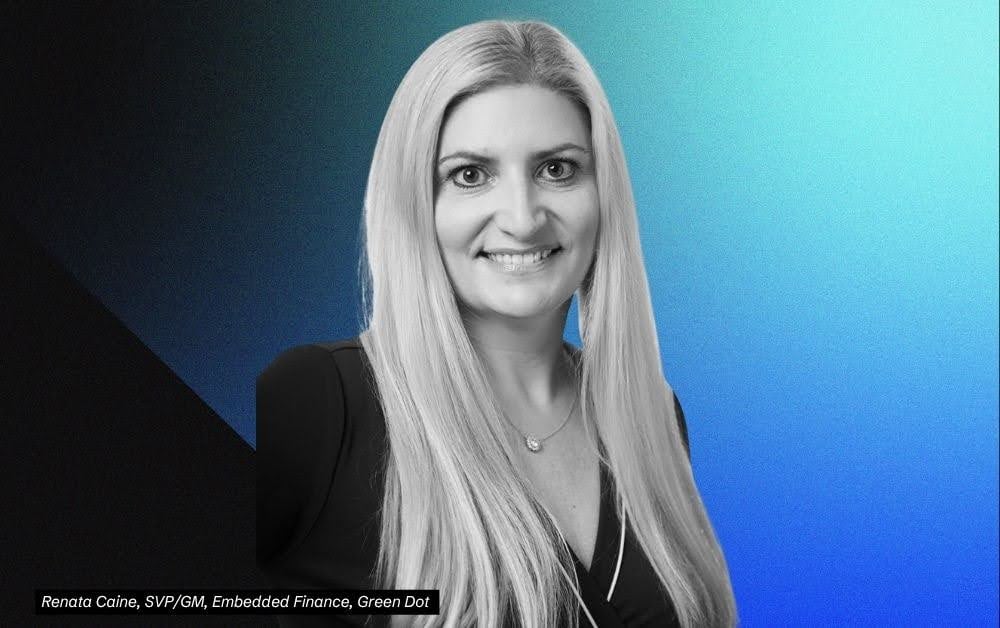
“We’re getting accustomed to the risk, the friction, the discomfort, because the value is so high to the downstream customer,” Renata Caine said.
“We’re getting accustomed to the risk, the friction, the discomfort, because the value is so high to the downstream customer,” Renata Caine said.
Fintech-forward bank Green Dot (NYSE: GDOT) runs the gamut: powering everything from Apple Cash and Samsung Pay to a range of cash-to-formal-banking onramps for low-to-moderate income consumers. The co powers 80 million accounts both directly through 7,000-plus partners, and hosts a retail network that spans 90,000+ locations nationwide. That breadth means Green Dot is something of a swiss army knife, but also — at least from a unit-economic perspective — occasionally on both sides of a contentious industry issue.
On the sidelines of Money 20/20, Fintech Nexus spoke with Renata Caine, Green Dot’s SVP/GM of Embedded Finance, about the company’s dual purpose as a bank as well as a fintech-infrastructural layer, and its placement in the market in the midst of open-banking debates, other regulatory murkiness, and shifting client-risk tolerance.
The following has been edited for length and clarity.
What’s standing out to you in 2025?
I’ve been in this industry for about 20 years, and it's been super interesting to see an evolution from payments into an ecosystem, where “payments” has a totally different meaning today: There's so much optionality.
So I've been at Green Dot for about 18 months, and joined at a really exciting time. It was right before we launched Arc by Green Dot: It’s all the pieces that you need to bring embedded finance to market. So it's the FDIC-insured accounts, the technology layer on top of that, the human-intensive program management — all the risk and the compliance and everything else.
It came at a really interesting time. You know, last year, there were some very public failures in our industry, and a lot of the failures were really because there wasn't transparency between the partners. It happened right before Money20/20 that we announced Arc last year, and people were talking about regulation so much last year. I think this year, when we think about regulation — we did a survey coming into Money20/20, like we did last year — and, of 515 respondents, 92% said that there are one or more risks that they worry about, which makes sense; but interestingly, 93% say they're highly satisfied. So what I take from that, is we’re getting accustomed to the risk, the friction, the discomfort, because the value is so high to the downstream customer, these brands take this chance, because they want that stickiness.
I think we saw some slowing down of regulation this year. In my opinion, I don’t think it changed much for folks. It certainly didn't for us; with regulation comes forced discipline. You build best practices, you make sure you're doing things by the book. And when that regulation slows down, I don't think that discipline goes away. You’ve built that muscle memory. We're smarter as an industry today.
Also, you still have state regulation.
Yes, which is, almost scarier, because there are so many states versus having national regulation: you make sure you've got 50 states covered. So, yes, I think that is worrisome. It could lead to much more complexity, for sure.
How do you telegraph to customers that you’ve got the finger on 50 state-level pulses, as well as the national pulse, in addition to a commitment to staying full-steam ahead?
You know, it's interesting. In the survey, something like 65% of fintechs weren't concerned about regulation. So the truth is, we don't get a lot of questions from the customers. We know now what discipline means, we know the resources we need to stay above board. The customers don't dig in. Our partners don't dig in. They trust us.
|