|
Trogni’s vision for Zinnia is industry standardization and full-stack, in the literal sense: “I strongly believe you cannot fix data and technology from the middle down. You have to start at the origination point...Our goal is to ensure that every family in North America has the financial longevity to match their wellness and health longevity."
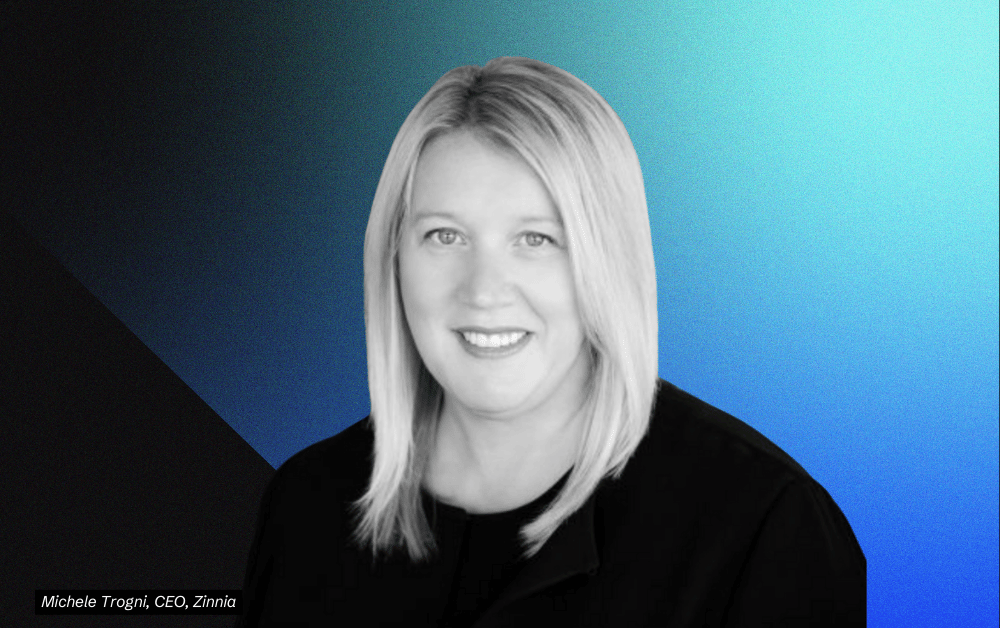
If you ask Zinnia CEO Michele Trogni about the transformation of the insurance industry, she’ll answer in the same disarmingly practical register she uses to recount a career that moved from the heights of Swiss banking at UBS to the vanguard of financial services at Markit.
It’s an MO that couples well with the drive to transform industries she’s brought to Zinnia, which enables carriers and distributors to build, sell, and service insurance, with the goal of helping people get the coverage they need and the service they deserve.
Unlike many startup CEOs, though, Trongi has less of a singular obsession with disruption and more a respect for infrastructure and an appreciation for building the “plumbing of the financial world.”
“We used to call ourselves the plumbers of financial services,” she said of her time at Markit, now IHS Markit, not with irony but with pride, in building the rails that move billions of dollars, less visible perhaps than other flashy financial products, but indispensable. “Before we built them, it was like all the plumbing that served the industry better needed to be plumbed in one way as opposed to everybody building it themselves.”
Trogni’s route through the jungle of global finance began in Britain. Her core career was in banking for 25 years, starting at UBS, where she worked her way up to become Group CIO, and she helped the company through the global financial crisis, which tore through the markets in 2008, requiring a massive rethink of banking, coupled with changing regulatory regimes.
However, Trogni was ready to pursue what she felt would become a dominant positive force in banking–financial technology. She decided to join Markit, where she led portfolios focused on data insights, analytics, and transformative technology solutions for financial markets.
“The thing that excited me about being in financial services was the amount of technology and the way it changed the shape of the industry over time,” Trogni said. “Once the financial crisis was through, there was a huge push in financial services to essentially think about technology, data, and the business in a totally different way.”
But not every financial services company could afford to build up an entire technology infrastructure. That led Trogni to think about what differentiated Markit and what technology it could build versus what it should buy from people who built it best.
Across Worlds: Banking, Fintech, Insurtech
While at Markit, Trogni oversaw a transition from startup to IPO and on to a blockbuster merger with IHS. That company then merged with S&P Global in 2022.
After leaving the company, the mother of four children decided to take a few years to be more present for them, but also to do board and advisory work. She ended up on the board of life insurance company Global Atlantic, where she found them wrestling with the problem she had spent a career solving: building technology with a focus on life insurance and annuities.
“It was an interesting business, and there was a huge opportunity here to replicate what was done in financial services, but in life annuities,” Trogni said.
She described life annuities as “very complicated products” in terms of both the number of attributes that are associated with an annuity or life insurance product, and the timelines; these products can last for decades. But the industry was years behind even the banking industry in its approach to digital transformation.
“You can buy insurance products and you have to hold it for like, 30 or 40 years, or you buy an annuity and it can last you for the next year, 10,15, or 20 years,” she said. “However, the infrastructure was horrendous. There was no one good at building this technology.”
|